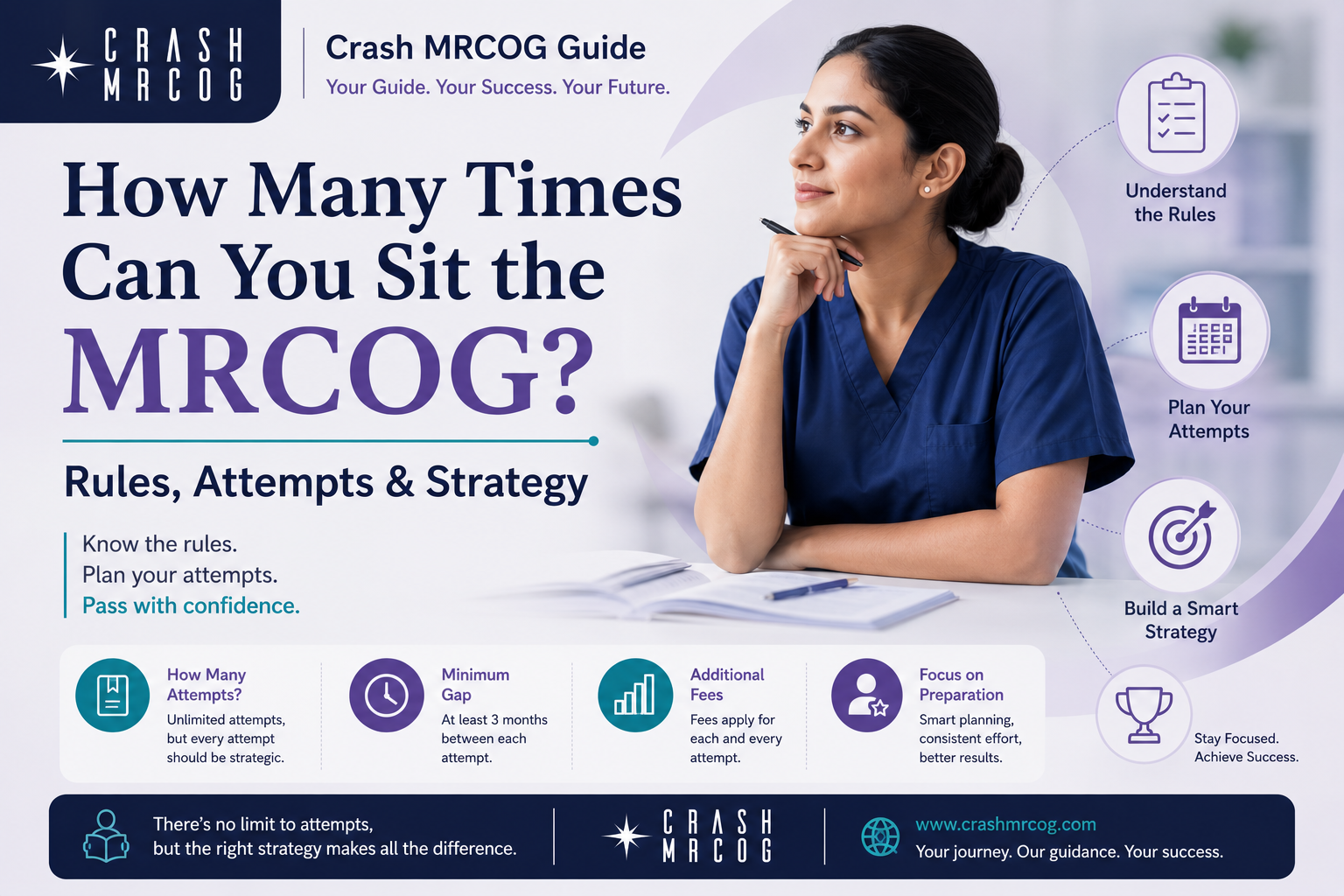
How Many Times Can You Sit the MRCOG? Rules, Attempts & Strategy
How Many Times Can You Sit the MRCOG? Rules, Attempts & Strategy
UK specialist training candidates can sit MRCOG Part 1 and Part 2 a maximum of 6 times each, and MRCOG Part 3 a maximum of 4 times. International candidates face no attempt limit for Parts 1 and 2, but are also capped at 4 attempts for Part 3.
MRCOG Attempt Limits at a Glance
The rules differ significantly depending on whether you are in UK specialty training or sitting the exam as an international candidate. Understanding exactly where you stand before you book your first attempt — not after your fourth — is one of the most important strategic decisions you will make. A failed attempt that you hadn’t planned for can dramatically narrow your options inside an already tight training timeline.
The RCOG publishes its official attempt and currency rules in a document titled DRCOG & MRCOG Exam Eligibility Criteria. The table below summarises the rules directly from that document.
Exam Part
UK Specialist Register Candidates (CCT trainees)
International / Overseas Candidates
MRCOG Part 1
6 attempts maximum; further attempts require Head of School sign-off
No limit on attempts
MRCOG Part 2
6 attempts maximum; further attempts require Head of School sign-off; first attempt must be within 7 years of passing Part 1 (pro rata up to 10 years for LTFT)
No limit on attempts; first attempt must be within 10 years of passing Part 1
MRCOG Part 3
4 attempts maximum; failure to pass within 4 attempts requires re-sitting Part 2; first attempt must be within 7 years of passing Part 2
4 attempts maximum; failure to pass within 4 attempts requires re-sitting Part 2; first attempt must be within 7 years of passing Part 2
MRCOG Part 1: The 6-Attempt Rule
If you are a UK CCT trainee aiming for the Specialist Register, you have a hard cap of 6 attempts at Part 1. After 6 fails, any further attempt requires written supporting documentation from your Head of School — this is not a rubber-stamp process and should not be assumed to be automatically granted. International candidates have no attempt cap, but still need to comply with the Part 2 currency window from the date they pass Part 1.
[INTERNAL LINK: MRCOG Part 1 exam format and preparation guide — Part 1 overview page]
[CTA: Start your Part 1 preparation today — Try CrashMRCOG Part 1 Question Bank Free]
MRCOG Part 2: The 6-Attempt Rule and the 7-Year Clock
UK trainees get 6 attempts at Part 2. Running parallel to the attempt cap is the currency rule: if you passed Part 1 after March 2013, you must make your first attempt at Part 2 within 7 years of that Part 1 pass date. If you are in less-than-full-time (LTFT) training, this extends pro rata to a maximum of 10 years. Miss the 7-year window without having attempted Part 2 even once, and you will need to re-sit Part 1 entirely — so do not let this clock run quietly in the background.
International candidates face a longer window — 10 years from passing Part 1 — with no cap on attempts. Note that the RCOG excluded 2020 and 2021 from this 10-year count for international candidates as a COVID-19 concession, though this is a historic provision and you should confirm current rules directly with the RCOG if it affects your timeline.
[INTERNAL LINK: MRCOG Part 2 written exam guide — Part 2 overview page]
MRCOG Part 3: The Tightest Rules of All
Part 3 is where the rules become most unforgiving. Both UK trainees and international candidates are limited to just 4 attempts at the MRCOG Part 3 clinical assessment. If you exhaust all 4 attempts without passing, the RCOG requires you to re-sit and pass Part 2 before you can attempt Part 3 again. This is a significant setback, as it resets your entire final-stage journey and burns additional attempt credits on Part 2.
The currency window adds further pressure: you must make your first attempt at Part 3 within 7 years (pro rata) of passing Part 2. Delaying Part 3 for career or personal reasons while that clock runs could leave you with fewer attempts than you think you have.
[INTERNAL LINK: MRCOG Part 3 OSCE preparation guide — Part 3 overview page]
What Happens If You Fail to Attend on the Day?
A key rule many candidates overlook: if you withdraw after the closing date or fail to appear on exam day, the RCOG counts this as a forfeited fee, but — critically — it does not count the no-show as a formal attempt. Your attempt counter is not incremented. However, you still lose the full exam fee, and extenuating circumstances refunds are considered on a case-by-case basis under the RCOG’s Exams Extenuating Circumstances Policy.
How Training Timeline Pressure Shrinks Your Real-World Attempts
The raw attempt numbers above do not tell the full strategic story. UK specialist trainees work within a fixed training programme, and your deanery or National Training Number (NTN) carries its own progression requirements. A candidate who first sits Part 2 in the latter half of ST5 and fails may only have two or three realistic re-sit windows before the training programme timeline demands an extension — and extensions are not guaranteed. This means the practical ceiling of meaningful attempts can be far lower than the regulatory maximum of six.
Think about it this way: 6 attempts sounds reassuring, but with only two sittings per year (typically January and July for Part 2), 6 attempts spans a potential three-year window. Factor in your CCT date and NTN constraints, and the exam demands your very best effort from sitting one — not sitting four.
[CTA: Don’t leave your attempts to chance — Access CrashMRCOG’s structured revision programme]
Strategic Advice: Making Every Attempt Count
Given the tight attempt limits, particularly for Part 3, every sitting should be treated as if it is your last. A structured approach to each attempt dramatically increases your conversion rate and reduces the emotional and financial cost of repeated sittings.
Sit Part 2 early within your training — giving yourself the maximum number of re-sit windows before training progression forces your hand
Do not sit before you are ready — an early exploratory attempt is not a neutral act; it costs money, an attempt credit, and, for UK trainees, visibility in your deanery’s data
Request detailed feedback after every fail — the RCOG provides results letters approved by the Examination and Assessment Committee; use this to direct your next preparation cycle, not just to confirm you failed
Track your Part 1 pass date from day one — set a calendar reminder for the 7-year window and make your Part 2 timeline explicit in your personal training plan
Plan Part 3 immediately after passing Part 2 — with only 4 attempts and a 7-year clock, Part 3 should never be an afterthought
Consult your Head of School early if you are approaching your attempt limit — the exceptional-circumstances route is real but not guaranteed, and early engagement is always better than a last-minute appeal
Frequently Asked Questions
How many times can I sit MRCOG Part 1?
UK trainees aiming for the Specialist Register can sit MRCOG Part 1 a maximum of 6 times. Any attempt beyond 6 requires supporting documentation from your Head of School confirming exceptional circumstances. International candidates have no attempt limit for Part 1.
How many times can I sit MRCOG Part 2?
UK specialist training candidates are permitted a maximum of 6 attempts at MRCOG Part 2. International candidates have no cap on attempts, but must make their first attempt within 10 years of passing Part 1. Further attempts beyond 6 for UK trainees require Head of School approval.
How many times can I sit MRCOG Part 3?
Both UK trainees and international candidates are limited to 4 attempts at MRCOG Part 3. If you do not pass within 4 attempts, you must re-sit and pass Part 2 before you can attempt Part 3 again. This applies universally — there is no distinction between UK and international candidates for Part 3.
What happens if I use all my attempts at MRCOG Part 3?
If you exhaust all 4 attempts at Part 3 without passing, the RCOG requires you to go back and re-sit Part 2. This resets your Part 3 attempt clock and requires you to pass Part 2 again before re-entering the Part 3 pathway.
Does a no-show or withdrawal count as an attempt?
No. If you fail to attend the exam on the day, the RCOG does not count this as a formal attempt against your total. However, you will forfeit your exam fee. Exceptional-circumstances refunds may be available under the RCOG’s Exams Extenuating Circumstances Policy.
How long do I have to attempt MRCOG Part 2 after passing Part 1?
UK trainees who passed Part 1 after March 2013 must make their first attempt at Part 2 within 7 years of their Part 1 pass date. This extends pro rata up to a maximum of 10 years for less-than-full-time trainees. International candidates have 10 years from passing Part 1 to make their first Part 2 attempt.
What is the 7-year rule for MRCOG Part 3?
After passing Part 2, you must make your first attempt at Part 3 within 7 years (calculated pro rata for LTFT trainees). If you do not attempt Part 3 within this window, you will be required to re-sit Part 2 before attempting Part 3.
Can I still sit MRCOG if I am not in UK specialty training?
Yes. International candidates outside UK specialty training face no attempt limit for Parts 1 and 2. They do, however, face the same 4-attempt cap at Part 3 as UK trainees. Currency windows also apply, so it is essential to track your Part 1 and Part 2 pass dates carefully.