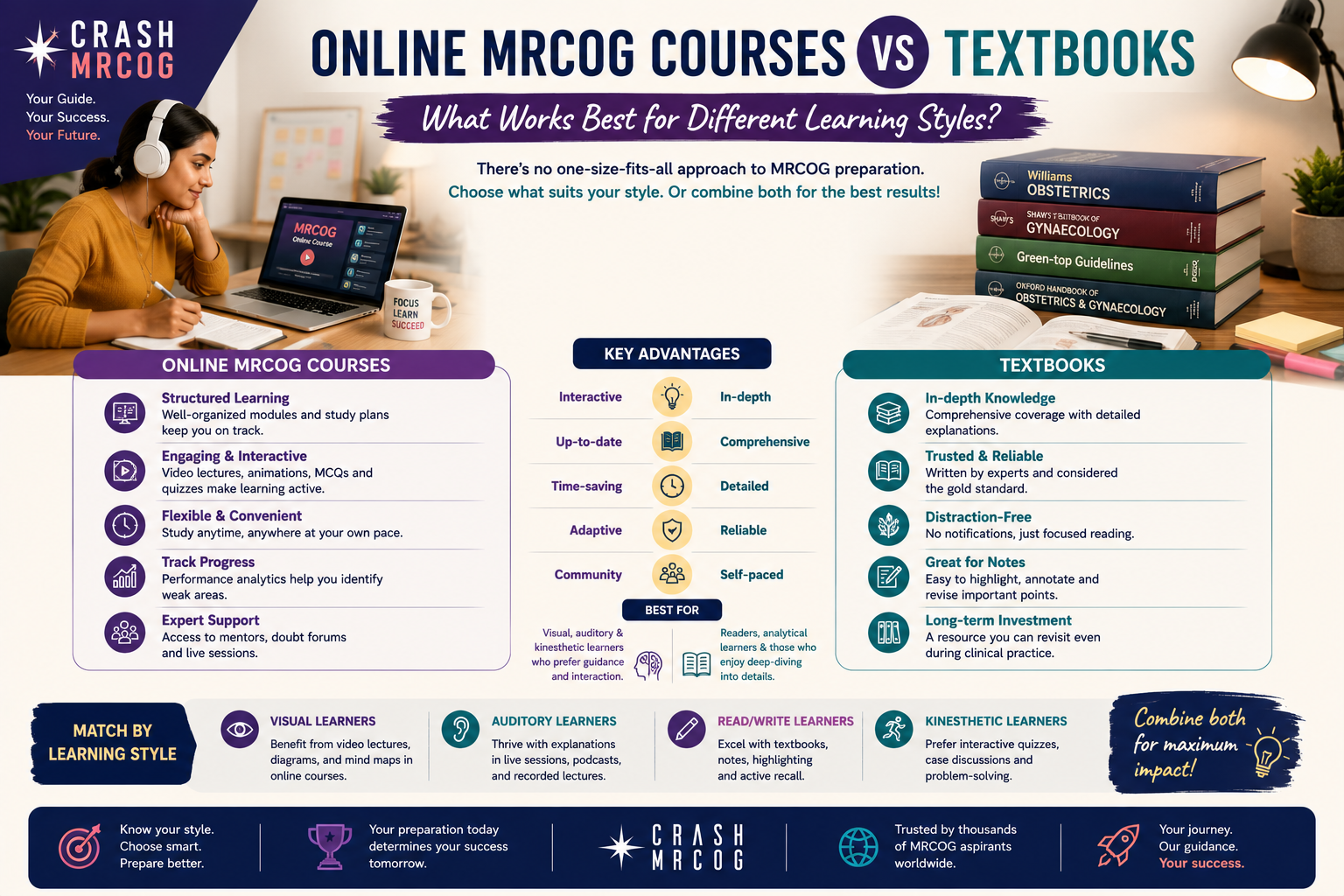
Online MRCOG Courses vs Textbooks: What Works Best for Different Learning Styles?
Online MRCOG Courses vs Textbooks: What Works Best for Different Learning Styles?
For MRCOG preparation, online courses and question banks consistently outperform textbooks alone — especially for Parts 2 and 3 — because the exam tests the latest guidelines, not static book knowledge. The most effective strategy combines both formats, using textbooks for foundational concepts and online platforms for active recall, guideline currency, and exam-style practice.
Why the Textbook-Only Approach Falls Short
Many candidates start MRCOG preparation by buying a stack of textbooks. The problem is structural: O&G is a guideline-driven specialty, and the exam is tightly aligned with the most current RCOG Green-Top Guidelines, NICE guidance, TOG articles, and specialist guidelines from FSRH, BASHH, and BHIVA. As one experienced candidate puts it, “If you use books as your resources for revision, you need to be cautious of when they were printed as the answers may have changed as new guidelines are coming in.” [web:5] A textbook printed even 18 months ago may contain clinical thresholds or management recommendations that have since been superseded. For Part 2 in particular, there is no single recommended textbook — the RCOG’s own guidance is explicit that “book-based learning is not enough for this exam.”
This does not make textbooks useless. For Part 1, which tests basic science heavily — embryology, physiology, pharmacology, anatomy — a well-chosen reference text provides the structured foundational knowledge that question banks alone cannot deliver. The Oxford Revision Notes and the Cambridge Part 1 MRCOG textbook remain popular among high-scoring candidates for exactly this reason. The key is understanding what each resource type is built to do, and matching it to both your learning style and the demands of the specific part you are sitting.
The Online Advantage: Currency, Interactivity, and Flexibility
Online MRCOG platforms solve the currency problem by design. RCOG eLearning (formerly StratOG) contains 97 core knowledge e-tutorials built specifically to align with the Part 2 syllabus and updated as guidelines change. Platforms like CrashMRCOG go further, embedding direct links to authoritative reference material within question explanations so that you are always reading primary sources. This matters enormously for a candidate who might otherwise spend hours cross-referencing a book chapter against a Green-Top Guideline update.
Online platforms also accommodate time-poor trainees far more effectively than textbooks. A registrar covering on-calls and busy clinical commitments cannot always guarantee a two-hour reading block, but they can work through SBAs during a commute or consolidate a guideline summary on a phone between ward rounds. Revision courses — many now delivered virtually — add a further layer: they identify knowledge gaps, improve exam technique, and provide motivational structure at a point in preparation where morale often dips. The consensus from successful candidates is that courses complement knowledge, but cannot substitute for the hours spent acquiring it.
Part-by-Part Breakdown: What the Evidence Suggests
MRCOG Part 1
Part 1 is the one paper where a targeted textbook genuinely earns its place. The basic sciences — physiology, biochemistry, pharmacology, anatomy, embryology, microbiology — require conceptual depth that guideline summaries do not provide. The RCOG’s own reading list includes Basic Sciences for Obstetrics and Gynaecology as a core reference. However, textbooks must be used alongside a high-volume question bank like Part 1 Crash MRCOG Question Bank. Completing large numbers of SBAs under timed conditions is what exposes the gap between recognising information passively and applying it under exam pressure. Successful candidates recommend using Oxford Revision Notes for depth, and CrashMRCOG for question volume and self-testing.
MRCOG Part 2
For Part 2, the primary evidence source is guidelines — not textbooks. The minimum reading list includes all RCOG Green-Top Guidelines, all relevant NICE guidelines, RCOG Scientific Impact Papers, FSRH, BASHH, BHIVA, BGCS and NHSCSP guidance, and TOG articles from the previous four years.
Online platforms solve the access and organisation problem: RCOG eLearning provides 97 curriculum-mapped modules, while question banks like CrashMRCOG allow topic-based self-testing against current guideline content. Reference textbooks by Andrew Sizer and Justin Konje remain useful for clinical context, but should supplement rather than anchor your preparation. Attending a structured revision course — whether the RCOG official course, or other course — is valuable in the final two months to sharpen exam technique and identify residual knowledge gaps.
MRCOG Part 3 (OSCE)
Part 3 is predominantly a clinical skills and communication examination. Textbooks have almost no direct role here. Online OSCE preparation courses, video examples of structured consultations, and live practice with a study partner are the formats that translate into exam performance. Platforms offering structured OSCE scenarios with examiner-level feedback are significantly more valuable than any reading resource for this component. CrashMRCOG Part 3 Course
Practical Strategy: How to Combine Both
The most efficient MRCOG revision strategy treats textbooks as a reference layer and online platforms as the active learning engine. This is how to structure it:
Map the syllabus first. Download the MRCOG Part 1 or Part 2 curriculum and divide it into knowledge domains. This prevents aimless reading and ensures your time is proportional to exam weighting.
Do questions before reading. Run a timed block of SBAs on a topic cold, then use your wrong answers to drive your reading. This active retrieval approach is more effective for long-term retention than passive reading first. [web:18]
Read the CrashMRCOG topic summaries. This will save you enormous amount of time reading the guidelines line by line.
Build a numbers notebook. Statistics — incidence figures, sensitivity and specificity values, success rates — appear frequently in the exam and are easy to confuse. Keep a dedicated physical or digital notebook exclusively for numbers. CrashMRCOG topic summary dedicate a table at the end of each topic summarizing the important numbers.
Audit your question bank performance by topic. Most online platforms allow you to filter performance by subject area. Use this data weekly to redirect your study toward red zones rather than reinforcing comfortable topics.
Frequently Asked Questions
Can I pass MRCOG Part 1 using only textbooks?
Textbooks alone are unlikely to be sufficient. While they are essential for building the basic science foundation that Part 1 requires, active question practice is what converts passive knowledge into exam performance. Most successful Part 1 candidates combine a core reference text (such as Oxford Revision Notes or the Cambridge Part 1 MRCOG textbook) with a high-volume question bank like CrashMRCOG.
Is book-based learning enough for MRCOG Part 2?
No — the RCOG and experienced educators are explicit that book-based learning alone is insufficient for Part 2. The exam is built on the most current guidelines, and textbooks cannot stay current with the volume and frequency of guideline updates. You must read primary guidelines directly (Green-Top, NICE, FSRH, BASHH, TOG) and test yourself on online platforms that are updated to match current evidence. CrashMRCOG give helps you with both as it offer up to date topics summaries, along with the largest pole of Part 2 MRCOG questions.
What is the best online course for MRCOG Part 2?
There is no single best course — the right choice depends on where you are in your preparation and what you need.
I’m a visual learner — what MRCOG resources should I prioritise?
Focus on resources that present information diagrammatically. CrashMRCOG teaching notes feature mind maps that summaries each topic and highlights concepts. These mind maps are designed specifically for visual retention.
How do I use a study buddy effectively for MRCOG revision?
The most effective study buddy sessions are structured, not open-ended. Agree a specific topic or set of guidelines to review independently before each session, then meet via video call to work through practice questions together on an online platform. This approach forces both of you to retrieve knowledge actively rather than passively re-reading, and the discussion that follows wrong answers deepens retention significantly.