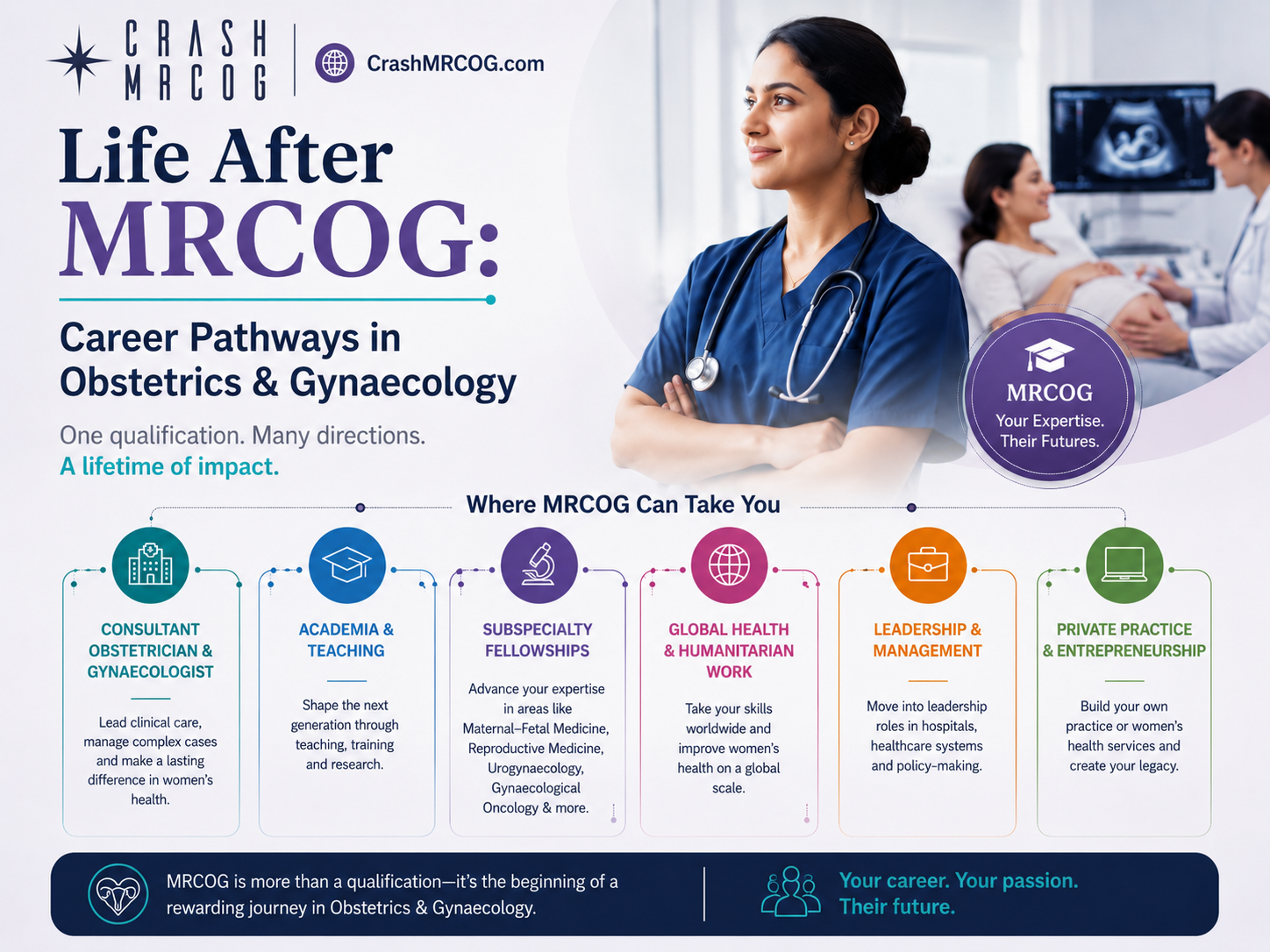
MRCOG can lead to consultant obstetric and gynaecology practice, subspecialty training, academic medicine, leadership roles, international work, or a hybrid career. The best route depends on your interests, training system, and long-term goals, so use the qualification as a platform rather than a final destination.
What MRCOG means for your career
Earning the MRCOG is a major milestone. It shows a strong base of knowledge and judgement in obstetrics and gynaecology. For many doctors, it is the point where exam work ends and career choices begin. You may stay in training, move into specialist practice, pursue a subspecialty, take a service role, or combine clinical work with research, teaching, leadership, or global health.
This article is for doctors preparing for all parts of MRCOG who want a clear view of life after MRCOG. It explains the main career paths in obstetrics and gynaecology, what each route usually involves, where the qualification helps, and how to plan the next five to ten years.
There is no single “best” path after MRCOG. The right route depends on your stage of training, your country of practice, your family needs, your interest in theatre or labour ward work, and whether you want breadth, depth, or leadership. MRCOG can open doors, but you still need to choose the door that fits your goals.
How MRCOG changes your professional options
MRCOG is widely recognised as evidence of advanced knowledge in obstetrics and gynaecology. In many settings, it can strengthen your profile for consultant posts, senior specialist roles, fellowship applications, and some international opportunities. It can also add weight to your CV when you apply for subspecialty training, leadership posts, academic work, or jobs that want a clear clinical benchmark in women’s health.
That said, MRCOG is not the end point of development. It is a platform. Employers still look for workplace competence, communication, practical skill, teamwork, audit and governance experience, and a record that fits the role. A doctor with MRCOG but no clear career story may struggle more than a doctor who has used the qualification to build a focused portfolio.
Definition box: after MRCOG, your career usually moves along one or more of four broad tracks: consultant service delivery, subspecialty or advanced practice, academic and research work, and leadership or international/global health roles. Many good careers combine more than one track.
The main career pathways after MRCOG
Once you have MRCOG, the most common routes in obstetrics and gynaecology can be grouped into the pathways below. Titles and training structures vary by country, but the career logic is similar.
Pathway
What it suits
Typical work
How MRCOG helps
Consultant obstetrician and gynaecologist
Doctors who want broad clinical responsibility
Clinics, theatre, labour ward, ward rounds, on-call, governance
Shows advanced knowledge and readiness for senior work
Subspecialty-focused practice
Doctors who want depth in one area
Maternal-fetal medicine, gynaecological oncology, reproductive medicine, urogynaecology, minimal access surgery
Strengthens applications for higher training and fellowship posts
Academic medicine
Doctors interested in teaching and research
Studies, publications, student teaching, curriculum work, grant applications
Supports scholarly credibility and commitment to the specialty
Builds authority for senior posts and management work
International, humanitarian, or global health work
Doctors drawn to wider health impact
Training, maternity care support, guidelines, capacity building, emergency response
Provides recognised specialist status in many settings
Private practice or hybrid practice
Doctors seeking flexibility and autonomy
Outpatient care, elective procedures, second opinions, procedure-based services
Supports credibility with patients and referrers
Consultant practice after MRCOG
For many doctors, the most familiar route after MRCOG is consultant obstetric and gynaecology practice. In the UK and similar systems, this usually means completing the required training pathway, building evidence of competence, and moving into a senior role with independent decision-making, supervision of junior doctors, and service design work.
Consultant work is broad and demanding. You may spend part of the week in antenatal clinic, part in gynaecology clinic, time in theatre, labour ward cover, emergency assessment, multidisciplinary meetings, and governance sessions. The role often suits people who like variety, can move quickly between obstetric and gynaecological problems, and are comfortable balancing patient care with teaching and leadership.
The key point for MRCOG candidates is that a consultant post is not only about technical skill. You also need to prioritise well, document clearly, communicate with patients and colleagues under pressure, and make safe decisions when resources are limited. The exam supports these skills, but workplace practice asks for steady judgement over time.
Subspecialty pathways after MRCOG
Some doctors use MRCOG as the step toward a narrower and more advanced field. This can be the right choice if you enjoy one part of the specialty enough to focus your future work there.
Maternal-fetal medicine
This pathway suits doctors who enjoy high-risk obstetrics, fetal medicine, complex antenatal counselling, and multidisciplinary decision-making. It often involves detailed ultrasound work, fetal surveillance, maternal medicine input, and care for pregnancies affected by medical disorders or fetal anomalies. The pace is intense and the work is intellectually demanding.
Gynaecological oncology
Gynae oncology combines surgery, cancer pathways, pathology, chemotherapy collaboration, and careful communication. It suits doctors who are comfortable with complex surgery and want long-term involvement in cancer care. The emotional load can be high, so resilience and empathy matter as much as technical skill.
Reproductive medicine and fertility
This route appeals to doctors who enjoy endocrinology, ultrasound, procedures, and patient-centred counselling. Fertility practice often means balancing science, ethics, expectations, and commercial pressures. It can suit doctors who prefer planned care and follow-up over acute emergency work.
Urogynaecology and pelvic floor medicine
Urogynaecology is a strong choice for those interested in continence, prolapse, pelvic floor dysfunction, and reconstructive work. It needs careful history-taking, strong pelvic anatomy knowledge, and a sensitive, patient-centred approach.
Minimal access and advanced benign gynaecological surgery
Doctors who love theatre may build a career around laparoscopic and hysteroscopic surgery. This route often requires good hand-eye coordination, patience, anatomical respect, and a willingness to keep improving technical skill over many years.
Subspecialty careers usually need extra training, mentorship, case exposure, and a record of commitment. MRCOG matters, but it is only one part of the application. You also need a clear portfolio that shows why your choice is realistic and sustainable.
Academic and research careers after MRCOG
If you like answering questions, not just treating patients, academia may suit you. Many obstetricians and gynaecologists combine clinical work with research, teaching, publishing, and exam or curriculum work. MRCOG can strengthen your profile because it shows a solid clinical base and a serious interest in the specialty.
An academic path may include a higher degree, clinical research posts, trial work, systematic reviews, teaching medical students, curriculum development, or contribution to guideline and education work. This route may fit doctors who enjoy reading widely, asking careful questions, and turning evidence into better care.
You do not need to be a full-time researcher to have an academic profile. Many clinicians build a hybrid career that keeps patient contact while leaving space for scholarly work.
Leadership, governance, and service redesign
Some of the most influential doctors in obstetrics and gynaecology are not only strong technically, but strong at improving systems. After MRCOG, you may move into roles that shape waiting times, emergency pathways, labour ward safety, patient experience, or quality improvement across a unit or network.
These roles need a different skill set. You need data awareness, an understanding of risk, confidence in multidisciplinary meetings, and the ability to work with managers. Good leaders in O&G are often calm, organised, and clinically credible. MRCOG helps because it gives you authority with clinical colleagues, but leadership is built through visibility and trust.
If you enjoy governance, incident review, and pathway redesign, start building that profile early. Join audit work, morbidity meetings, guideline review, and committee work. These experiences can make you more competitive for senior jobs and help you understand how departments work.
International and global health opportunities
MRCOG is recognised in many countries. For doctors who want to work internationally, it can be a useful asset. Some use it to return home with stronger credibility; others use it to apply for international posts, humanitarian work, NGO roles, teaching jobs, or system-strengthening projects.
Global health work in obstetrics and gynaecology often focuses on reducing maternal mortality, improving emergency obstetric care, strengthening referral systems, training healthcare workers, and supporting women’s health services in resource-limited settings. This work can be rewarding, but it is not easy. It needs humility, cultural awareness, adaptability, and a strong ethical approach.
If you are thinking about an international career after MRCOG, be realistic about local licensing, visa rules, workforce needs, and the scope you can safely practise in. MRCOG may help, but it does not replace local registration or employer rules. Always check the relevant regulator and guidance before you move.
Private practice and hybrid careers
Some consultants and specialists combine public-sector work with private practice. Others move into full-time private work in selected settings. A hybrid career can offer flexibility, but it also brings responsibility: you must maintain clinical standards, informed consent, safe escalation, and clear boundaries between public and private work.
Private practice in O&G is varied. It may involve fertility consultations, gynaecology clinics, obstetric scans, second opinions, minor procedures, elective surgery, or follow-up after treatment. The best private practitioners are not just visible; they are reliable, clear, and trusted by patients and referrers.
For MRCOG holders, the qualification can support credibility in private settings, especially when paired with a strong consultant profile. If private work is your goal, think carefully about indemnity, local rules, scope of practice, and clinical governance.
Choosing the right route after MRCOG
The right pathway is not the one that sounds most impressive. It is the one you can sustain. Ask yourself a few simple questions: Do I want broad practice or a narrow area? Do I enjoy emergencies or planned work? Do I want theatre-heavy work, clinic-heavy work, or a balance? Do I want more time in teaching, research, or management? Do I want to stay in one country or keep international mobility?
One useful way to think about this is to match the career route to your day-to-day energy. If labour ward emergencies energise you, obstetrics or maternal medicine may fit. If you prefer continuity and procedures, fertility or benign gynaecology may suit you better. If you enjoy complex conversations and systems, oncology or leadership may be stronger fits. If you want to create evidence, academic work may be your best path.
If you enjoy…
Consider…
Why it may fit
Fast decisions and acute care
Obstetrics, maternal-fetal medicine
Frequent emergency work and multidisciplinary care
Theatre and technical precision
Minimal access surgery, gynae oncology, advanced benign surgery
Procedure-heavy and anatomy-focused work
Long-term follow-up and counselling
Fertility, urogynaecology, benign gynaecology
Continuity and patient education matter
Teaching and evidence
Academic medicine
Research, publications, and education are central
Improving systems
Governance and leadership
Impact on pathways, safety, and service quality
How to build your post-MRCOG portfolio while preparing for the exam
Do not wait until you pass MRCOG to think about your career path. Your current training years are the best time to build evidence. Choose activities that tell a clear story. If you want subspecialty work, build exposure in that area. If you want leadership, take on governance tasks. If you want academia, focus on audit, presentations, publications, and teaching.
Employers and fellowship panels look for consistency. A scattered CV with unrelated activity is usually weaker than a focused one that shows real interest. That does not mean you should stop exploring. It means your extra work should support the career you want after MRCOG.
The first mistake is assuming the exam automatically decides the next job. It does not. MRCOG improves your profile, but you still need direction. The second mistake is chasing prestige rather than fit. A route that looks impressive can become tiring if it does not match your strengths.
The third mistake is underestimating the non-clinical side of career growth. References, interview skills, portfolio presentation, leadership evidence, and reflective practice all matter. The fourth mistake is waiting too long to commit to a direction. You do not need to choose forever, but you should choose enough to build momentum.
The fifth mistake is ignoring geography and licensing. A route that works in one system may not be straightforward in another. If you plan to move country, check registration, training equivalence, employer expectations, and visa rules early.
What employers look for after MRCOG
Whether you apply for a consultant job, a fellowship, or a senior specialist role, employers usually want more than clinical competence. They want reliability, communication, teamwork, judgement, professionalism, and the ability to fit into an existing service. MRCOG supports your application, but your daily behaviour will help secure the role.
They may also want proof that you understand the service context. Can you manage an obstetric emergency and communicate clearly with midwives, anaesthetists, neonatologists, and theatre staff? Can you counsel a patient in clinic without rushing? Can you support juniors while staying safe? Can you deal with complaints, governance issues, and risk conversations? These are the skills that separate exam success from senior practice.
How to talk about your career after MRCOG at interview
At interview, be specific. Do not say only that you want “more exposure” or “to grow as a doctor.” Say what kind of practice you want and why. Explain the experiences that shaped you, the cases or services that confirmed your interest, and the contribution you want to make.
A strong answer links past exposure, current skill, and future value. For example, a doctor interested in maternal medicine might describe experience with complex antenatal cases, teamwork with physicians, and a wish to develop expertise in high-risk obstetrics. A doctor interested in leadership might discuss audit work, rota coordination, and service redesign. The panel is not only assessing ambition; it is assessing coherence.
A practical roadmap for life after MRCOG
The best time to plan life after MRCOG is before you finish the exam. Start by deciding whether your ideal role is broad consultant practice, subspecialty development, academia, leadership, global health, or a hybrid. Then work backwards. Identify the placements, mentors, audits, teaching roles, publications, and interviews that support that route.
If you are still undecided, that is normal. Use your current rotations to test what energises you. Keep a record of the work that feels meaningful, the tasks that drain you, and the situations where you feel most useful. Career clarity often grows from repeated exposure, not one single moment.
If you are close to sitting the exam, do not let career planning distract you from passing MRCOG first. But do not separate the two completely either. The doctors who move confidently into the next stage are usually the ones who prepare for the exam with a clear picture of where they want it to lead.
Why MRCOG remains valuable after the exam
MRCOG is valuable because it signals commitment, knowledge, and readiness for higher responsibility. In obstetrics and gynaecology, where decisions can change outcomes quickly, that matters. It can improve mobility, credibility, and access to better opportunities, but it works best when paired with a clear career plan.
For doctors preparing for all parts of the exam, the message is simple: pass MRCOG, but do not treat it as an isolated goal. See it as a professional qualification that should shape the next stage of your life in a meaningful way. If you choose the right pathway, the years after MRCOG can be among the most rewarding of your career.
FAQs about life after MRCOG
These are the questions doctors most often ask when they are thinking about career options after MRCOG. The answers below are designed to help you make practical decisions, not just pass the exam.
Frequently Asked Questions
What jobs can I do after MRCOG?
After MRCOG, you can move toward consultant obstetric and gynaecology practice, subspecialty training, academic medicine, leadership roles, international work, or a hybrid career that combines several of these. The exact title and route depend on the country, training system, and local licensing rules. MRCOG strengthens your credibility, but employers still look for evidence of clinical competence, teamwork, communication, and a clear professional direction.
Does MRCOG guarantee a consultant job?
No. MRCOG is an important qualification, but it does not automatically guarantee a consultant post. Hiring panels usually assess the whole profile: training completion, clinical experience, audits, governance, teaching, leadership, references, and interview performance. In some systems, additional training or recognised eligibility criteria are also required. Think of MRCOG as a strong credential that improves your competitiveness rather than a final guarantee.
Which subspecialty is best after MRCOG?
There is no universally best subspecialty after MRCOG. The right one depends on what you actually enjoy and what kind of day-to-day work you want. Maternal-fetal medicine suits doctors who like complex obstetrics and risk management. Gynaecological oncology suits those who want advanced surgery and cancer care. Fertility, urogynaecology, and advanced benign surgery are also strong options. Choose the field that matches your strengths, stamina, and long-term goals.
Can I work abroad with MRCOG?
In many countries, MRCOG is respected and can improve your prospects, but it does not replace local medical registration or licensing requirements. Some employers may accept it as part of their eligibility criteria, while others will require additional assessments, local exams, supervised practice, or immigration documentation. If you want to work abroad, check the relevant medical regulator, employer policy, and visa rules before making plans.
Is academia a realistic career after MRCOG?
Yes, academia is a realistic and common route after MRCOG for doctors who enjoy research, teaching, and evidence-based practice. You do not need to be a full-time professor to build an academic profile. Many clinicians combine service work with audits, publications, teaching, postgraduate degrees, and guideline or quality-improvement projects. MRCOG gives you a strong clinical base that supports academic credibility.
How should I plan my career while preparing for MRCOG?
Use your current training time to build a focused portfolio that matches the career you want after MRCOG. If you want subspecialty work, seek relevant rotations and mentorship. If you want leadership, get involved in audit, governance, and service improvement. If you want research, prioritise publications and presentations. Keep your goals specific and realistic, because a clear story is much stronger than a scattered CV.