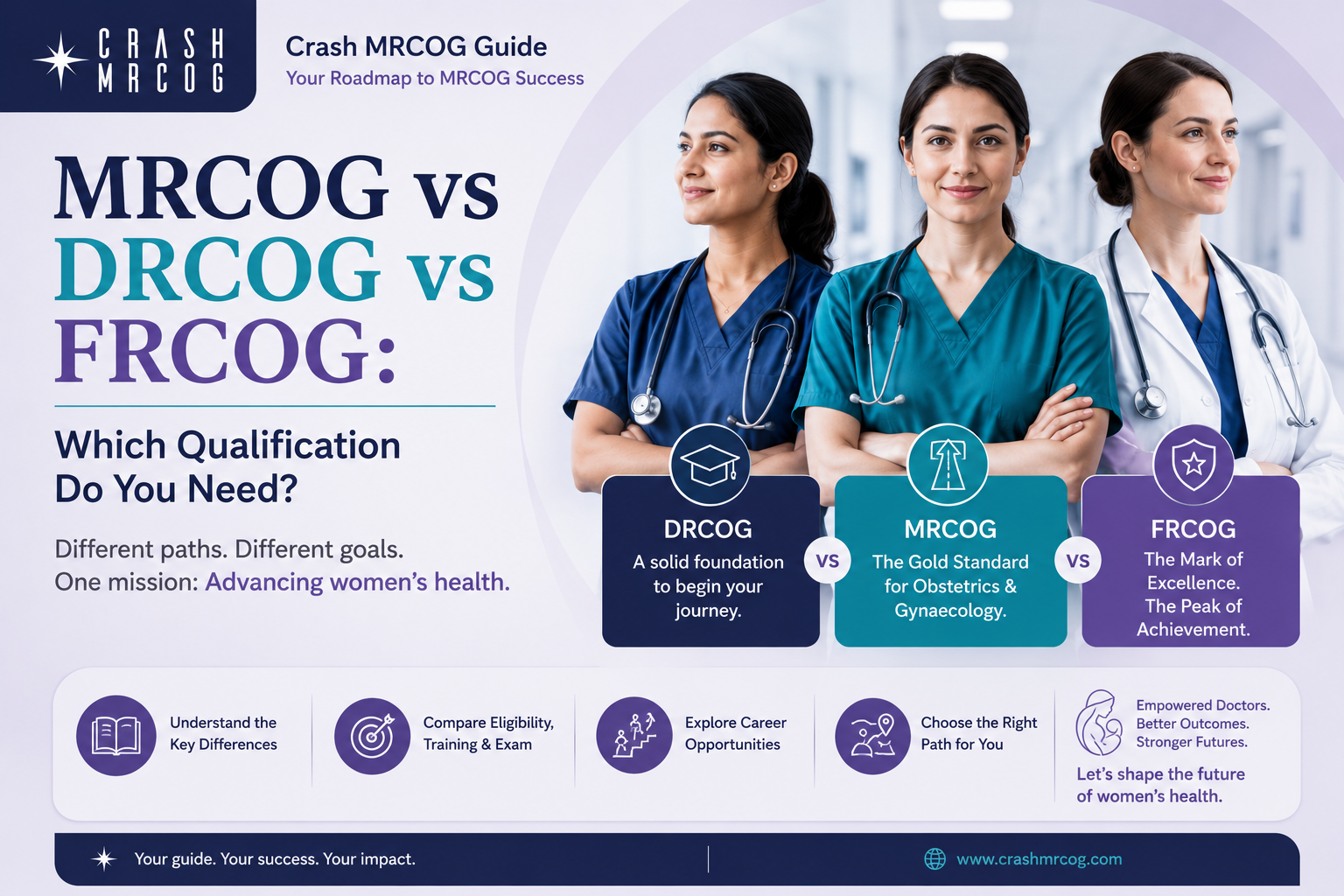
MRCOG vs DRCOG vs FRCOG: Which Qualification Do You Need?
MRCOG vs DRCOG vs FRCOG: Which Qualification Do You Need?
The DRCOG, MRCOG, and FRCOG are three distinct qualifications awarded by the Royal College of Obstetricians and Gynaecologists (RCOG), each serving a different purpose: the DRCOG is a diploma for GPs and non-specialists wanting to demonstrate competence in women’s health; the MRCOG is the gold-standard membership examination required for a career as an O&G specialist; and the FRCOG is a prestigious fellowship awarded to those who have made exceptional contributions to the field — it is not an exam you sit. What Each Qualification Actually Means Understanding what these three letters stand for is the first step to choosing the right path for your career.
What Each Qualification Actually Means
Understanding what these three letters stand for is the first step to choosing the right path for your career. All three are issued by the RCOG, but they represent fundamentally different levels of engagement with obstetrics and gynaecology.
DRCOG — Diploma of the RCOG
The DRCOG (Diploma of the Royal College of Obstetricians and Gynaecologists) is a single-exam qualification designed primarily for GPs, GP trainees, and non-specialist doctors who want to enhance their knowledge and demonstrate competence in women’s health. It does not lead to RCOG membership, and it does not qualify you as an O&G specialist. Think of it as a mark of enhanced interest and capability within a primary care context.
MRCOG — Membership of the RCOG
The MRCOG (Membership of the Royal College of Obstetricians and Gynaecologists) is the internationally recognised gold-standard qualification for doctors pursuing a specialist career in obstetrics and gynaecology. It is a three-part examination series that tests basic science, clinical knowledge application, and clinical skills. Passing all three parts grants you full RCOG membership and the right to use the post-nominal letters MRCOG, recognised in over 40 countries. [INTERNAL LINK: What is the MRCOG exam? — MRCOG overview page]
FRCOG — Fellowship of the RCOG
The FRCOG (Fellow of the Royal College of Obstetricians and Gynaecologists) is not an exam — it is an honour. It is awarded to MRCOG holders who have made a significant contribution to O&G through research, teaching, or publication, and those elected to fellowship normally will have been Members for at least 10 years. There are also honorary fellowships (Fellowship honoris causa and Fellowship ad eundem) awarded to individuals — including those outside medicine — who have demonstrated outstanding dedication and achievement in clinical care or development of women’s healthcare services.
Side-by-Side Comparison
Feature
DRCOG
MRCOG
FRCOG
Full name
Diploma of the RCOG
Membership of the RCOG
Fellowship of the RCOG
How obtained
Single exam
Three-part exam series
Awarded by merit / nomination
Target audience
GPs, GP trainees, non-specialists
Doctors pursuing O&G specialty training
Established MRCOG holders with exceptional contribution
Career outcome
Enhanced primary care scope in women’s health
Specialist O&G career, registrar and consultant posts
Prestigious recognition; no new clinical scope
RCOG membership?
No
Yes — full College membership
Yes — Fellow status
International recognition
Limited
Recognised in 40+ countries
High — but honorary in nature
Typical candidate stage
FY2, GP ST1–ST3, GP registrar
O&G core trainees and specialty registrars
Senior consultants, typically 10+ years post-MRCOG
The DRCOG in Detail
The DRCOG exam is a single computer-based assessment lasting three hours and comprising 120 single best answer (SBA) questions, each worth two marks, for a total of 240 marks. It runs twice a year — in March and October — and is sat at Pearson VUE centres across the UK and Ireland. There is no negative marking, and pass marks are determined through a modified Angoff standard-setting process, benchmarked against the level a competent GP trainee should achieve.
The DRCOG is especially valuable if you are a GP registrar completing an O&G placement, an FY2 doctor keen to demonstrate women’s health interest, or a doctor working in an O&G department who does not intend to sit the MRCOG. It is not a stepping stone to the MRCOG — the two qualifications serve different career paths.
The MRCOG is structured across three distinct parts, each building on the last. You must pass each part before progressing, and strict attempt limits and time limits apply throughout.
MRCOG Part 1
Part 1 tests basic and applied sciences relevant to clinical obstetrics and gynaecology. The exam consists of two papers, each lasting 2.5 hours and containing 100 SBA questions, for a total of 200 SBAs. Candidates have up to 6 attempts, and must attempt Part 2 within 7 years of passing Part 1 (extendable to 10 years pro rata for less-than-full-time trainees).
MRCOG Part 2
Part 2 assesses clinical knowledge application — including diagnostic reasoning, risk management, interpretation of guidelines, and complex clinical decision-making. It consists of two three-hour papers, each containing 50 SBA questions and 50 Extended Matching Questions (EMQs), for a total of 200 questions. Candidates have up to 6 attempts, and must attempt Part 3 within 7 years of passing Part 2.
MRCOG Part 3
Part 3 is an Objective Structured Clinical Examination (OSCE) that evaluates your ability to apply clinical skills in real-world contexts. Before applying, you must have completed an Assessment of Training (AOT). UK trainees need to be at ST3 level or above; overseas candidates require at least four years of full-time clinical training in O&G. You have a maximum of 4 attempts — if unsuccessful, you must resit Part 2 before trying again.
[INTERNAL LINK: MRCOG Part 3 OSCE preparation — MRCOG Part 3 guide]
[CTA: Start preparing for MRCOG today — Access full MRCOG question bank]
The FRCOG in Detail
The FRCOG is not something you apply for — it is something you are nominated for. For existing MRCOG holders, a fellowship may be awarded if you have made a significant contribution to O&G through research, teaching, or publication, and those elected typically will have been Members for at least 10 years. There are two honorary fellowship routes: Fellowship honoris causa (awarded to those demonstrating the highest level of clinical dedication, outstanding support in developing women’s healthcare services, or significant contributions to the RCOG) and Fellowship ad eundem (awarded to senior members of other relevant Royal Colleges). Neither route involves sitting an examination.
If your goal is career progression within the NHS or internationally, passing the MRCOG is what you need. The FRCOG is a recognition that comes later — if at all — and it adds prestige rather than new clinical entitlements.
[INTERNAL LINK: How to prepare for the MRCOG — MRCOG study strategy guide]
Which Qualification Is Right for You?
The answer depends entirely on your career trajectory. Use this as a quick guide:
You are a GP or GP trainee wanting to improve your management of women’s health conditions → DRCOG is the right choice. It demonstrates a meaningful commitment to primary care women’s health without the multi-year commitment of the MRCOG pathway.
You want to become a consultant obstetrician and gynaecologist or pursue any specialist O&G career → MRCOG is essential and non-negotiable. No UK or international O&G specialty training programme will take you seriously at registrar or consultant level without it.
You are an O&G consultant later in your career with significant research, teaching, or service contributions → You may be nominated for FRCOG. This is not something you pursue — it is something your peers and the RCOG recognise you for.
You are an international medical graduate (IMG) seeking UK O&G specialty training or a consultant post → MRCOG is your priority. It is recognised in over 40 countries and is the benchmark that shortlisting panels look for.
Frequently Asked Questions
Is DRCOG equivalent to MRCOG?
No. The DRCOG and MRCOG are not equivalent. The DRCOG is a diploma-level qualification for GPs and non-specialists; it does not grant RCOG membership and does not qualify you to work as an O&G specialist. The MRCOG is the full membership examination required for a specialist career in obstetrics and gynaecology.
Can I do DRCOG before MRCOG?
Yes, but the two qualifications serve different purposes and the DRCOG is not a prerequisite for the MRCOG. Some doctors working in O&G who are not yet ready to sit the MRCOG choose to do the DRCOG as evidence of their knowledge during training. However, if your goal is the MRCOG, focus your revision resources there — the syllabi overlap significantly but the DRCOG alone will not advance your O&G specialist career.
Do I need MRCOG to become a consultant gynaecologist in the UK?
Yes. You must pass all three parts of the MRCOG as part of the UK O&G specialty training pathway. Without the MRCOG, you cannot obtain a Certificate of Completion of Training (CCT) in O&G and therefore cannot be appointed to a UK consultant post.
How long does it take to get MRCOG?
There is no fixed timeline, as progress depends on when you sit and pass each part. However, most O&G trainees complete all three parts during their specialty training years (ST1–ST7), which spans approximately seven years. You must attempt Part 2 within 7 years of passing Part 1, and Part 3 within 7 years of passing Part 2 (with pro rata extensions for less-than-full-time trainees).
Is FRCOG higher than MRCOG?
Yes — in terms of prestige and seniority, FRCOG ranks above MRCOG. However, they are not comparable in the same way as exam grades: MRCOG is a qualification you earn through examination, while FRCOG is an honour awarded later in your career in recognition of outstanding contributions to the field. Most O&G consultants hold MRCOG; far fewer are awarded FRCOG.
Can I get FRCOG without doing MRCOG?
In most cases, MRCOG is a prerequisite for Fellowship. However, honorary fellowships — specifically Fellowship honoris causa and Fellowship ad eundem — can be awarded to individuals outside the normal membership route, including non-doctors, who have made exceptional contributions to women’s health or to the work of the RCOG. These are rare and nomination-based.
Does DRCOG help with GP appraisal or revalidation?
Yes. The DRCOG is widely recognised as evidence of ongoing professional development in women’s health for GPs. It can support your appraisal portfolio and demonstrate to your appraiser a commitment to maintaining and expanding your skills in obstetrics and gynaecology within primary care.
Is the MRCOG recognised outside the UK?
Yes. The MRCOG is internationally recognised and accepted as a specialist qualification in over 40 countries, making it highly valuable for doctors who trained internationally or who intend to work in multiple healthcare systems throughout their career.