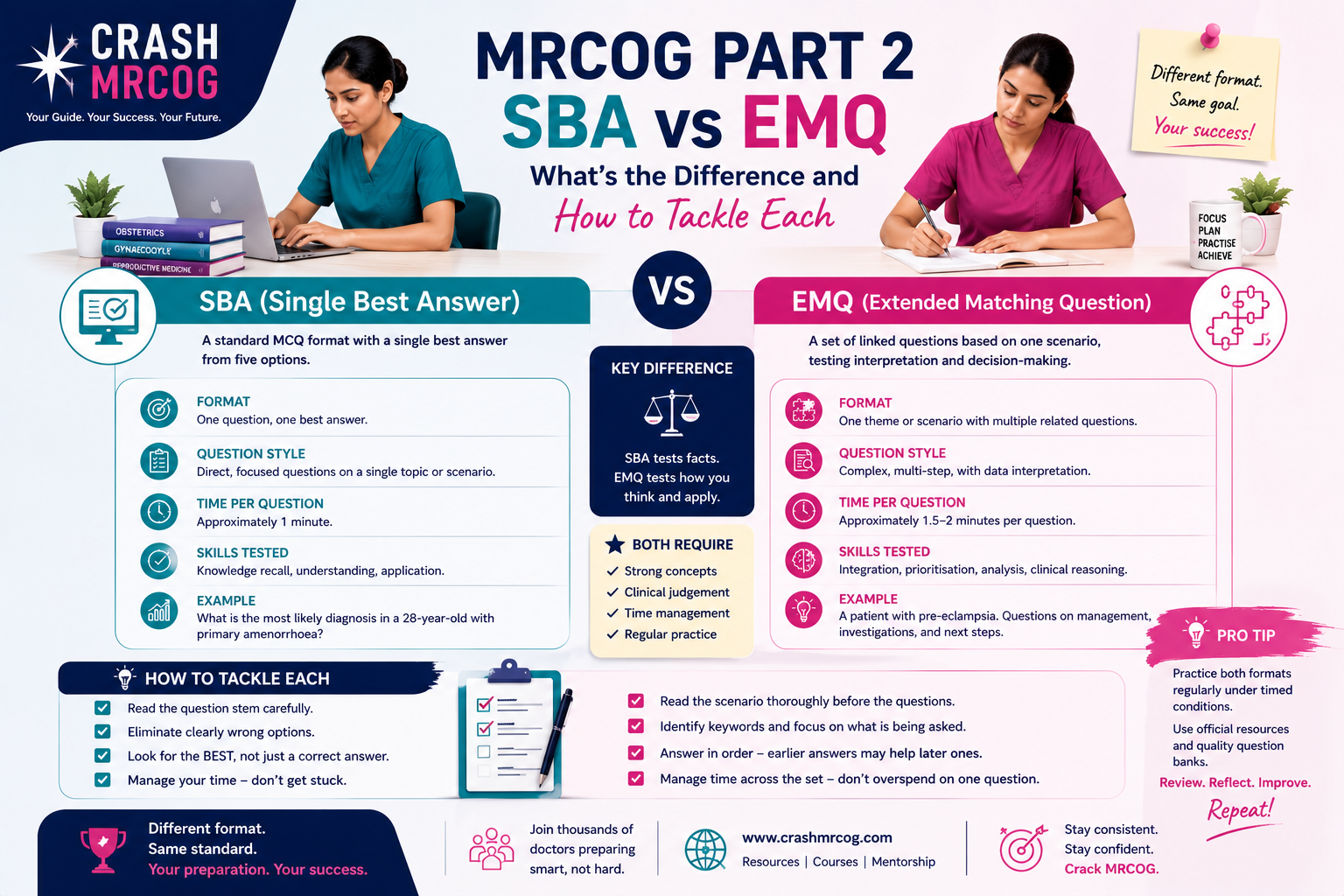
The MRCOG Part 2 written exam contains two question types: Single Best Answer (SBA) questions and Extended Matching Questions (EMQs). SBAs contribute 40% of marks in each paper with 5 answer options per question, while EMQs carry 60% of marks with 10–14 shared options across multiple clinical scenarios — making EMQ mastery the single biggest lever for improving your Part 2 score.
Last reviewed: 16 May 2026 — based on current RCOG, NICE, and BJOG guidelines.
Overview: The MRCOG Part 2 Written Exam Format
The MRCOG Part 2 written exam is a computer-based test (CBT) conducted at Pearson VUE centres worldwide. It consists of two papers taken on the same day with a lunch break in between. Understanding how SBAs and EMQs fit into the overall structure is the first step to building a targeted revision plan.
| Component |
Details |
| Total Questions |
200 (100 SBAs + 100 EMQs) |
| Papers |
2 papers (Paper A and Paper B) |
| Questions per Paper |
50 SBAs + 50 EMQs |
| Duration per Paper |
3 hours (180 minutes) |
| Total Exam Time |
6 hours |
| SBA Mark Contribution |
40% per paper |
| EMQ Mark Contribution |
60% per paper |
| Negative Marking |
None |
There is no separate pass mark for SBAs and EMQs — a combined pass mark is set through standard-setting for each sitting. Because EMQs carry 60% of marks, they deserve proportionally more of your preparation time.
What Is an SBA Question?
A Single Best Answer (SBA) question presents a clinical scenario followed by a lead-in question. You are given 5 answer options (A–E) and must choose the single most appropriate answer. Each SBA is entirely standalone — independent of every other question in the paper.
Key Features of SBAs
- Stand-alone questions — each is independent of all others
- 5 answer options per question
- Tests single-case clinical decision-making and guideline application
- RCOG recommends allocating 70 minutes for 50 SBAs per paper (approximately 1.4 minutes per question)
- Contributes 40% of marks per paper
How to Tackle SBA Questions
- Read the lead-in question first — before the clinical stem, so your brain extracts the right information from the scenario
- Apply RCOG and NICE guidelines — when two answers seem correct, the most guideline-aligned answer is almost always right
- Eliminate obvious distractors — removing 2 implausible options immediately improves your odds from 20% to 33%
- Never leave a blank — there is no negative marking, so a guess always beats no answer
- Flag and move on — any question taking more than 2 minutes should be flagged and revisited at the end of the SBA section
What Is an EMQ?
An Extended Matching Question (EMQ) presents a single theme — for example, “Management of Postpartum Haemorrhage” — with a shared option list of 10–14 answers. You are then given multiple clinical scenarios, typically 4 to 6, and must match each scenario to the most appropriate option from the shared list.
Each scenario within an EMQ theme is marked independently. This means you can score partial marks within a theme even if you get one scenario wrong — a key strategic difference from SBAs.
Key Features of EMQs
- Theme-based — multiple clinical scenarios share one option list
- 10–14 shared answer options per theme
- Tests pattern recognition and clinical reasoning across related scenarios
- RCOG recommends allocating 110 minutes for 50 EMQs per paper (approximately 2.2 minutes per question)
- Contributes 60% of marks per paper
- The same option can be the correct answer for more than one scenario within a theme
How to Tackle EMQ Questions
- Read the full option list before any scenario — spend approximately 60 seconds understanding all options before attempting the first scenario
- Answer each scenario independently — do not let your answer to one scenario influence your answer to another
- Focus on distinguishing clinical details — age, investigation result, gestational age, or a specific guideline threshold is usually the deciding factor between two similar options
- Eliminate clearly inappropriate options first — with 10–14 options available, systematic elimination is even more powerful than in SBAs
- Prioritise EMQs in your revision — aim for a 60/40 split of EMQ to SBA practice time to reflect the marks available
SBA vs EMQ: Side-by-Side Comparison
| Feature |
SBA |
EMQ |
| Answer options |
5 per question |
10–14 shared across scenarios |
| Question style |
Standalone |
Theme-based |
| Cognitive skill tested |
Single-case decision-making |
Pattern recognition across scenarios |
| Mark contribution per paper |
40% |
60% |
| RCOG recommended time |
70 minutes for 50 questions |
110 minutes for 50 questions |
| Time per question |
~1.4 minutes |
~2.2 minutes |
| Partial scoring within set |
No |
Yes |
| Same answer usable twice |
Not applicable |
Yes |
| Number per paper |
50 |
50 |
Time Management on Exam Day
The most common exam-day mistake candidates make is spending too long on SBAs and arriving at the EMQ section mentally fatigued with insufficient time. Follow the RCOG-recommended time split strictly and practise it in every full mock exam before the real sitting.
- SBAs: 70 minutes for 50 questions per paper
- EMQs: 110 minutes for 50 questions per paper
- Total per paper: 180 minutes (3 hours)
What Topics Do SBAs and EMQs Cover?
Both question types draw from the same MRCOG Part 2 curriculum. High-yield topics that appear frequently across both SBAs and EMQs include:
- Maternal medicine and medical complications in pregnancy
- Labour management and obstetric emergencies
- Gynaecological oncology
- Early pregnancy complications and miscarriage management
- Urogynaecology and pelvic floor disorders
- Subfertility and assisted reproduction
- Menstrual disorders and gynaecological endocrinology
- RCOG Green-top Guidelines and NICE clinical guidance
Mastery of RCOG Green-top Guidelines is essential — the majority of correct answers in both SBAs and EMQs are directly traceable to a specific guideline recommendation.
Frequently Asked Questions
What is the difference between SBA and EMQ in MRCOG Part 2?
SBAs present one standalone clinical scenario with 5 answer options and contribute 40% of marks per paper. EMQs present multiple clinical scenarios under a shared theme with 10 to 14 options and contribute 60% of marks per paper. SBAs test individual clinical decision-making while EMQs test pattern recognition across related scenarios.
How many SBA and EMQ questions are in the MRCOG Part 2?
There are 100 SBA questions and 100 EMQ questions in total, split equally across two papers. Each paper contains 50 SBAs and 50 EMQs, taken over 3 hours per paper.
Is there negative marking in MRCOG Part 2?
No. There is no negative marking in the MRCOG Part 2 written exam. Always answer every question — an unanswered question scores zero, whereas a guess carries a chance of scoring a mark.
How much time should I spend on SBAs vs EMQs?
The RCOG recommends 70 minutes for 50 SBAs and 110 minutes for 50 EMQs per paper. Practise this exact split in every mock exam before the real sitting to build reliable time discipline.
Which is harder — SBAs or EMQs?
Most candidates find EMQs more challenging because they require distinguishing between similar clinical scenarios using subtle differences. However, EMQs offer partial scoring within each theme, which SBAs do not. Both formats demand deep knowledge of RCOG Green-top Guidelines and NICE guidance.
How should I split my revision time between SBAs and EMQs?
Because EMQs carry 60% of marks per paper, aim to spend approximately 60% of your question practice time on EMQs and 40% on SBAs. High volume of practice across both formats is the strongest predictor of Part 2 performance.
Can the same option be used more than once in an MRCOG Part 2 EMQ?
Yes. The same answer from the shared option list can be the correct response to more than one scenario within the same theme. Each scenario is assessed independently.
All exam format information verified against the official RCOG website (rcog.org.uk). Last updated: 16 May 2026.